


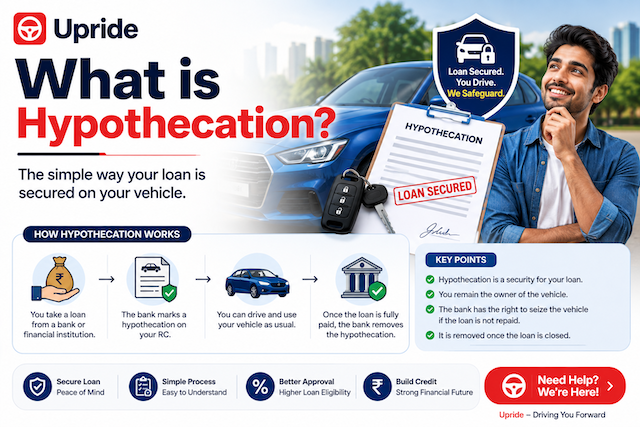
If you've taken a car loan, you've probably seen the word "hypothecated" printed on your Registration Certificate (RC). Most people don't fully understand what it means until it's time to sell the car or realise the bank's name is still sitting on their ownership papers. Here's a simple, clear explanation — and what to do about it once your loan is paid off.
What is hypothecation?
Hypothecation is a legal arrangement where you keep possession and use of your car, but the bank or financier holds a claim on it as security for your loan — without physically holding the vehicle. In simple words: you drive the car, but the bank has a legal right over it until the loan is fully repaid. This is exactly how most car loans in India work — the RC shows the vehicle as "hypothecated to [Bank Name]" for as long as the loan is active.
What is hypothecation removal in a car loan?
Once you've paid off your entire car loan, the bank no longer has any claim on your vehicle — but your RC doesn't update itself automatically. Hypothecation removal (also called hypothecation termination) is the official process of getting the bank's name cleared off your RC at the RTO, so the vehicle legally shows you as the sole, unencumbered owner. This step matters more than people realise — you can't sell the car, get certain insurance benefits, or apply for a fresh loan against it cleanly until hypothecation is removed.
How to remove hypothecation on a car in Bangalore
The process is largely the same across Karnataka's RTOs, and it's simpler than most people expect:
Get a No Objection Certificate (NOC) and Form 35 from your bank, confirming the loan is fully closed. Banks usually issue two signed, stamped copies.
Log in to the Parivahan Vahan portal, select Karnataka and your specific RTO, and choose the "Hypothecation Termination" service.
Enter your registration number and chassis number, then upload the NOC, Form 35, your RC copy, valid insurance, and PUC certificate.
Pay the termination fee online — typically ₹100 to ₹500 depending on vehicle type and whether a fresh smart-card RC is issued.
Submit the original documents at your RTO for final verification, or track status directly using your application number on Parivahan.
Once approved, a clean fee usually clears in 7 to 15 working days, and your updated RC (without the bank's name) is sent by post.
One thing worth checking before you apply: your bank's NOC is only valid for a limited window (often 90 days), so don't sit on it too long once you get it.
Where this process can get stuck
The bank hasn't digitally cleared the loan in the Vahan system yet, even though your EMIs are done — this needs a follow-up call to your bank's loan department
Mismatched registration or chassis number details between your Form 35 and RC
An expired bank NOC that needs to be reissued
Get it done without the back-and-forth
Hypothecation removal is one of those RTO processes that seems simple on paper but often stalls because of a bank delay or a small paperwork mismatch. If you'd rather not chase your bank and the RTO separately, message Upride on WhatsApp — Upride's consultants handle hypothecation clearance end-to-end across Bangalore's RTOs, and coordinate directly with your bank if the digital NOC hasn't come through yet.
For a simpler explanation of how hypothecation ties into buying or transferring a vehicle, see Upride's guide to hypothecation on a car, and if you're also transferring ownership at the same time, check the RC transfer guide.
Always verify your vehicle's hypothecation status and apply for termination through the official Parivahan Sewa portal. You can also read HDFC Bank's explainer on car loan hypothecation for the lender's side of how hypothecation works.