


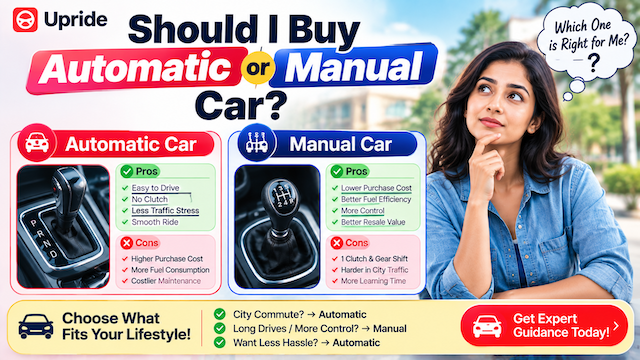
"Should I go for manual or automatic?" is one of the most common questions new car buyers ask, and honestly, there's no single right answer — it depends on where you drive, how much you drive, and what you're willing to trade off. Here's a clear, honest breakdown to help you decide.
The basic difference
A manual car has a clutch pedal — you shift gears yourself as speed changes. An automatic car (AMT, CVT, or torque converter) shifts gears on its own, so you only use the brake and accelerator. That's the whole difference in mechanics, but it changes a lot about daily driving.
Why manual has more to "do," but is more fuel efficient
Manual cars demand more from the driver — constant clutch and gear coordination, especially in stop-start traffic. It's genuinely more tiring in a city like Bangalore. But in exchange, manual cars are usually the more fuel-efficient option, since there's no torque converter or extra gearbox complexity draining engine power. They're also cheaper to buy — an automatic variant of the same car typically costs ₹60,000 to ₹2 lakh more, according to industry pricing data — and cheaper to service, since manual gearboxes have fewer parts that can fail.
Why automatic cars are popular with women drivers
Automatic cars remove the single hardest part of driving in traffic — constant clutch work — and that convenience is a big reason more women in India are choosing automatics. Auto industry data backs this up: automatic car sales in India have grown from 16 out of every 100 cars sold in 2016 to 26 out of every 100 today, and companies like Honda report that automatic transmissions make up 25–30% of their India sales, with noticeably higher demand from women buyers. It's not about ability — it's about not wanting to fight traffic and a clutch pedal at the same time, every single day.
The real trade-offs, side by side
Manual | Automatic | |
|---|---|---|
Cost to buy | Lower | Higher (₹60k–₹2L more) |
Fuel efficiency | Usually better | Usually slightly lower |
Ease in traffic | Tiring — constant clutch use | Easy — just brake and accelerator |
Maintenance cost | Lower, simpler repairs | Higher, more complex gearbox |
Control over the car | More direct control | Less direct, but smoother |
Best for | Highway driving, hilly terrain, budget buyers | City traffic, first-time drivers, daily commuters |
Less mileage in automatic, but no gear changing — that's really the core trade-off in one line. If your drive is mostly highway or you're watching every rupee of fuel cost, manual usually wins. If you're stuck in Bangalore traffic every day and comfort matters more than a slightly better mileage number, automatic is worth the extra cost.
What do experienced drivers say?
Automotive writers who've driven both for years generally land in the same place: if you're learning to drive, learn manual first — it gives you the flexibility to drive both car types later, while an automatic-only licence limits you to automatics. Real driver discussions on platforms like Reddit's r/CarsIndia community echo this too — most people who learned manual first say switching to automatic later took barely a day to get used to, while the reverse is much harder. Spinny's detailed comparison sums it up well: the "better" choice really comes down to your traffic conditions, budget, and how you personally connect with driving.
Automatic cars across budgets — official manufacturer links
If you've decided automatic is right for you, here's where to check current models and prices directly from the manufacturers:
Maruti Suzuki — widest automatic range in India, from the Alto K10 AMT to the Grand Vitara. Check current models on the Maruti Suzuki official site
Tata Motors — Tiago XTA, Punch AMT, Nexon AMT, and more. See the Tata Motors official site
Mahindra — automatic options across the XUV300, XUV700, and Scorpio-N range. See Mahindra Auto's official site
Hyundai — Grand i10 Nios, Venue, and Creta all offer automatic variants. See the Hyundai India official site
Kia — Sonet and Seltos both come with automatic options. See the Kia India official site
Budget-friendly automatics generally start around ₹6–7 lakh (Alto K10 AMT, Tiago XTA, WagonR AGS), while mid-range SUVs with automatic transmission usually fall in the ₹10–15 lakh bracket (Sonet, Venue, Nexon).
Upride trains you on both — and even in your own car
Here's the good part: you don't actually have to pick blind. Upride offers full training on both manual and automatic cars, so you can try both before deciding what to buy. If you already own a car, Upride also runs sessions specifically to help you get comfortable driving your own vehicle — useful whether you just bought a new automatic and want to build confidence, or you're switching from manual to automatic after years of driving stick.
Check out Upride's manual car training and automatic car training packages, or read more on learning to drive in your own car in Bangalore.
Already decided? Upride can help you buy, register, and drive it
Once you've picked your car, Upride's help doesn't stop at training. If you're buying a used automatic or manual car, you'll need an RC transfer to put the vehicle in your name — Upride's RC transfer guide walks through the process, and you can always verify your registration details on the official Parivahan Sewa portal. And if you're still torn between two specific models, Upride's team can talk you through the real day-to-day differences based on how and where you actually drive — not just spec sheets.
📲 Message Upride on WhatsApp to figure out whether automatic or manual is the right fit for you, and get trained on whichever one you choose.