


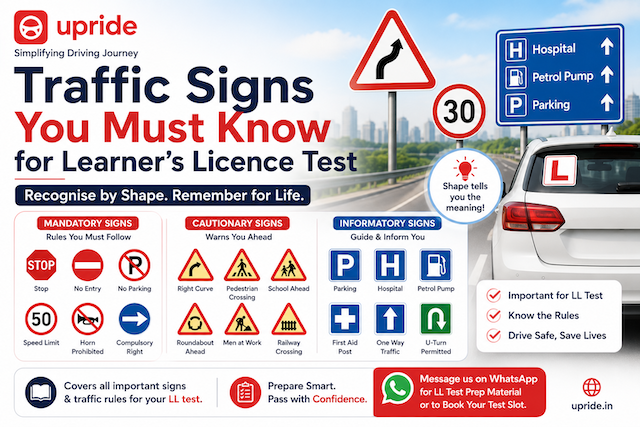
If you're preparing for your Learner's Licence (LL) test, traffic signs will make up a big chunk of your questions. The good news: once you understand the three categories they fall into, most signs become easy to recognise by shape and colour alone — even before you read a single word on them.
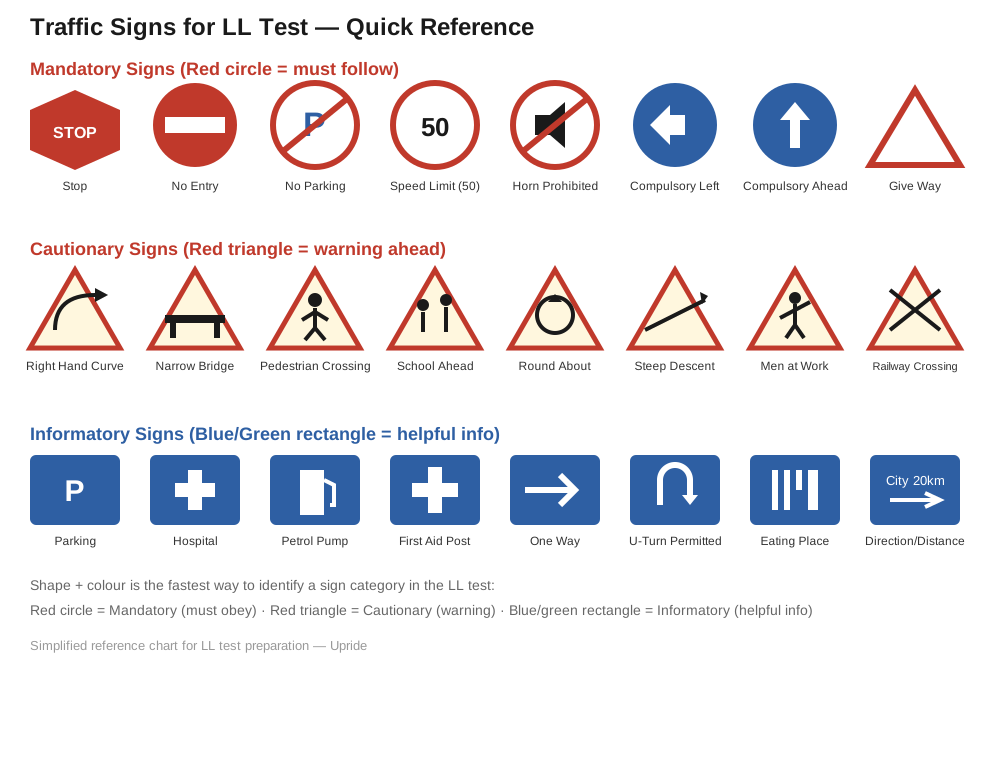
The three categories, and how to tell them apart instantly
Under the Indian Roads Congress (IRC) classification, every traffic sign in India falls into one of three groups:
Mandatory signs — circular, usually with a red border or solid red fill. These are rules you must follow. Ignoring one isn't just a test mistake — it's a punishable offence on the road.
Cautionary signs — triangular, red border on a pale yellow background. These warn you about something ahead — a curve, a crossing, a narrow bridge — so you can slow down and react in time.
Informatory signs — rectangular, usually blue or green. These simply guide you — nearest hospital, parking, fuel station, distance to a city. No obligation, just useful information.
Quick memory trick: shape tells you the category before you even read the sign. Circle = obey it. Triangle = watch out. Rectangle = helpful info.
Mandatory signs you'll be tested on
Stop — octagonal, red, self-explanatory: come to a complete halt.
No Entry — red circle with a white bar: this road isn't open to you.
No Parking / No Stopping — red circle with a diagonal line through a "P."
Speed Limit — red-bordered circle showing the maximum speed allowed.
Horn Prohibited — red-bordered circle with a crossed-out horn.
Compulsory Left/Right/Ahead — solid blue circle with a directional arrow, meaning that's your only permitted direction.
Give Way — inverted white triangle with a red border: yield to other traffic.
Cautionary signs you'll be tested on
Right-hand / Left-hand curve — a curved arrow showing the bend direction ahead.
Narrow bridge — warns the road ahead narrows significantly.
Pedestrian crossing — a walking figure icon; slow down for people crossing.
School ahead — figures of children; a strong cue to reduce speed.
Roundabout ahead — circular arrow icon.
Steep ascent / descent — an incline arrow, common on ghat and hill roads.
Men at work — a digging figure icon, indicating roadwork ahead.
Unguarded railway crossing — a crossed "X" icon; no barrier, so you check both ways yourself.
Informatory signs you'll be tested on
Parking — blue square with a "P."
Hospital — blue square with a red cross or "H."
Petrol pump — blue square with a fuel pump icon.
First aid post — blue square with a cross.
One-way traffic — blue rectangle with a directional arrow.
U-turn permitted — blue square showing a looping arrow.
Other traffic rules that come up alongside signs
The LL test doesn't stop at signs — expect questions on seatbelt and helmet rules, mobile phone use while driving, the meaning of traffic light sequences (red = stop, yellow = get ready, green = go), right-of-way at unmarked intersections, safe following distance, and lane discipline on highways. A few rules worth knowing cold:
Traffic lights: a flashing yellow means proceed with caution, not stop completely.
Right of way: at an unmarked junction with no signal, vehicles already on the roundabout or main road generally have priority.
Overtaking: always from the right, and never near a curve, junction, or pedestrian crossing.
Emergency vehicles: ambulances, fire trucks, and police vehicles with sirens on always get the right of way — pull over and let them pass.
These usually pair with a sign-based question in the test, so understanding both together helps more than memorising signs in isolation.
Why this matters beyond the exam
It's easy to treat traffic signs as something to memorise once and forget. But every sign exists because of a real, repeated cause of accidents — a blind curve, a school zone, an unguarded crossing. Knowing them isn't just how you clear the LL test; it's what actually keeps you, your co-passengers, and pedestrians safe once you're driving for real.
How Upride helps you prepare
Beyond handling your paperwork, Upride puts together proper, simplified LL test prep content covering exactly these sign categories and related rules — the same ones actually asked in the exam — so you're not guessing which parts matter or studying from an overloaded, cluttered PDF.
📲 Message us on WhatsApp for LL test prep material or to book your test slot.
Knowing these signs isn't just about passing an exam — it's what keeps you and everyone else on the road safe, long after the test is over.